
Old Jail Release Records
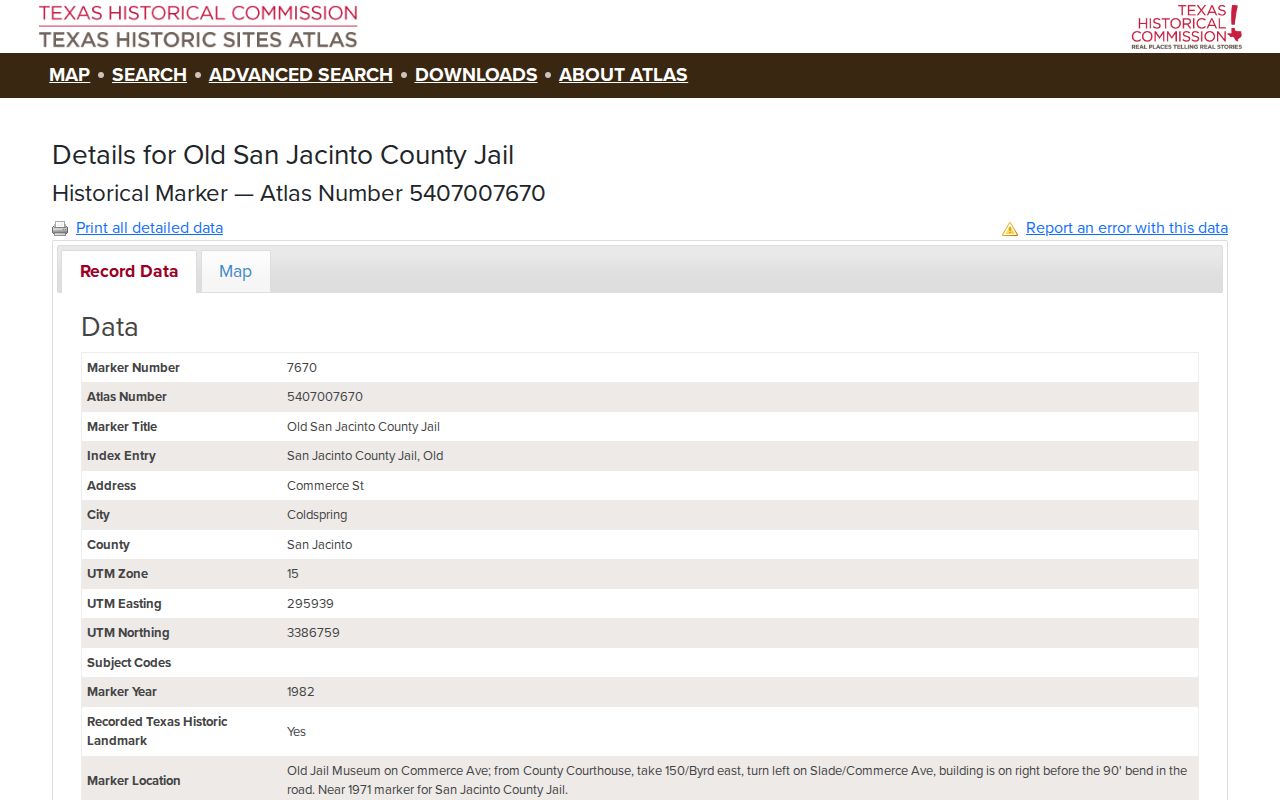
The Texas Historical Commission identifies the Old San Jacinto County Jail as a structure authorized in 1886, completed in 1887, and used as the county jail until 1980. It included jailer quarters and upstairs cells. Those facts make it useful for interpreting an archival court, sheriff, newspaper, or family record. They do not make the landmark a current records custodian.
No person is now booked, confined, transferred, or released from this building. It produces no present roster entry, notification, release sheet, or custody log. Modern release questions go to the San Jacinto County Sheriff's Office at the operating jail. If a modern local detainee was housed elsewhere, the sheriff's transport or destination entry should identify the receiving custodian.
Confirm an Old Jail Release
Begin with the date on the source. A record dated during the old jail's operation may require archival county material. A record after 1980 should not be routed to the landmark. Use the current sheriff, the correct clerk, and any receiving agency shown in the custody trail.
- Read the full source and record its date, name spelling, cause number, booking reference, and court.
- Confirm the landmark's history through the Texas Historical Commission entry.
- Ask the appropriate county custodian whether it holds the archival sheriff, jail, or court series for that period.
- For a modern event, contact the current sheriff and request the booking/release sheet or custody log.
- Match a release authority to the court record, then follow any transfer destination into the receiving system.
The historic commission page supplies context rather than a name search.
San Jacinto Archive Identifiers
Older records can be difficult to match because spelling, indexing, and record series change across decades. Capture the identifiers already present before contacting an office. A cause number is especially helpful. San Jacinto County's modern clerk workflow limits broad staff research, so a precise archival request is more useful than a name-only question.
| Identifier | Why it helps |
|---|---|
| Record date | Separates the old jail era from modern custody |
| Cause or docket number | Points to the correct court file |
| Full name and variants | Reduces a false match in older indexes |
| Charge or sentence | Connects the jail reference to a legal event |
| Book-out or transfer note | Shows whether custody ended or moved |
A court judgment can explain time served, sentence completion, bond, dismissal, or another authority. It does not necessarily record the minute physical custody ended. When available, pair it with the sheriff or jail record that documented the exit.
Modern San Jacinto Release Route
The current San Jacinto County Jail is at the sheriff's Cedar Avenue address in Coldspring. The official sheriff page links IVSS-Counties but has no public roster or release archive. A missing IVSS result does not prove release because a former detainee may disappear from the custody search. Call 936-653-4367 and ask whether the person left the jail, on what disposition, and whether another agency received custody.
Request existing records under Texas Government Code Chapter 552. A focused request identifies the person and date range and asks for the booking/release sheet, book-out time, reason or authority, and transfer destination. The sheriff has not published dedicated records hours, a local fee schedule, or a confirmed public-record email, so confirm the submission method by phone.
The current San Jacinto County Jail release route addresses modern events in detail. Do not send a current family pickup or custody question to the historic landmark.
Two San Jacinto Custody Eras
The old jail and the modern detention center tell sharply different stories. One is a preserved nineteenth-century building that ceased jail service in 1980. The other is the sheriff's current custody operation. Hurricane Beryl damage in July 2024 added a third location problem because prisoners were held outside San Jacinto County for a period while detention at the damaged center was prohibited.
This creates a simple but vital timeline. A pre-1980 reference may relate to the old structure. A later booking belongs to the current sheriff. A record during the 2024 disruption may keep a local case number while physical custody sits in another county. In each case, ask who held the person on the date in question.
- Historic reference
- A record or source tied to the former jail era.
- Release
- The end of a stated custodian's confinement, which may or may not mean freedom from all custody.
- Transfer
- Movement from one custodian to another.
- Custodian
- The agency that maintains the custody event and related records.
Old Jail Contact Limits
The historic site has no modern inmate information line, release desk, records hours, or release-processing schedule. It cannot verify whether a living person is in custody. Current records belong with the sheriff, local clerks, TDCJ, BOP, ICE, USMS, or another county as the facts require.
Historic reference sourceOld San Jacinto County Jail
San Jacinto County, Texas
Operating custody status: none
Modern release inquiries: San Jacinto County Sheriff's Office, 936-653-4367
For a county court record, first determine whether the matter was a misdemeanor, felony, or justice-court case. Use the cause number and request the signed order or judgment. For a transferred person, the receiving agency's later record controls the next custody event.
Note: Never infer a modern release from a visit, map result, or historical listing for the Old San Jacinto County Jail.
Reading Old Jail Release Terms
Historic entries should be transcribed before interpretation. Preserve the exact exit word, date, nearby headings, and any destination. “Removed” may describe transport. “Discharged” may end one jail entry without resolving another cause. A court minute may state authority but omit the time the jailer completed it. Keeping the source wording prevents a modern meaning from being imposed on an older record.
Records may be divided among sheriff, clerk, court, archive, and historical holdings. A jail register can show admission and departure while a docket supplies the charge and order. Ask which office now holds the named series. Give the year, volume or page, cause number, and spelling variants. A precise request is more useful than a broad request for everything about one name.
If an inquiry crosses 1980, separate its events. The old jail ceased operating, but a case could create later records elsewhere. The current sheriff handles a modern booking. TDCJ handles a later state prison or parole event. Federal and ICE tools apply only when a documented transfer points there. One name can have records under several custodians without making the landmark a current facility.
Texas public-record law gives access to government records subject to exceptions, but an office need not create a narrative or perform open-ended research. Ask for a register entry, docket, order, booking record, or release record. Retention, condition, sealing, expunction, juvenile rules, or another lawful limit may affect access. An absent archival record is not proof that custody never occurred.
For modern self-search, use the correct clerk and cause number. The County Clerk does not conduct broad judicial research for requesters, and the District Clerk does not accept copy requests by email. Those present rules do not prove how an older archive is indexed. Call first, name the series, and confirm the delivery and copying process.
Old Jail Record Boundaries
The historical landmark page and a custody record serve different aims. The commission entry documents architecture, dates, and former use. It does not identify each person held or released. A name-level claim needs the government register, docket, order, or another source that actually names the person. Keep the commission citation for facility context and the custody source for the event.
Copies may be uncertified or certified. Ask the clerk what form is available and what a certification proves. Certification authenticates the copy held by that office; it does not add facts that the record lacks. If the request concerns the physical release time or receiving agency, a court copy alone may not answer it.
Note the research date when recording modern contact rules. Office processes, custodians, and digitized holdings can change. Recheck the county source before sending payment or traveling. Do not assume the historic site has staff able to retrieve records merely because it appears on a map or tourism listing.