
TDCJ San Jacinto Release Paths
No TDCJ prison or state jail is listed inside San Jacinto County. A person transferred from the county jail enters a statewide assignment system and may be held at any proper TDCJ unit. The county of conviction does not identify the current unit or the place where release will be processed. TDCJ IVSS follows the person across unit moves and into parole or mandatory supervision.
A state record can describe several different points. An expected or projected release date is prospective. A scheduled release date appears after further review and can still change. A release date records a completed state transition. Parole and mandatory supervision end incarceration but continue legal supervision. A flat discharge ends the stated sentence, though another cause or authority could still act.
| TDCJ field | Meaning |
|---|---|
| Offender Status | Current state custody or supervision position |
| Facility | Current assigned TDCJ location |
| Expected or Projected Release Date | A calculation, not proof of completed release |
| Scheduled Release Location | Planned processing site, subject to change |
| Release Date | Recorded state release event |
Confirm a TDCJ Release
Search the TDCJ IVSS offender search by name, State Identification number, or current TDCJ number. A separate option handles prior TDCJ numbers. Open View Details and compare identifiers before relying on a match. Name alone can select the wrong person.
- Enter the strongest identifier and inspect the matching detail record.
- Read Offender Status, Facility, Expected Release Date, Release Date, and history as separate items.
- Check parole-review information if release depended on a Board decision.
- Use general inmate information for an unclear online result, or the stage-specific Board and release-processing number.
- Request the state record when exact release time, transfer, or calculation documentation is needed.
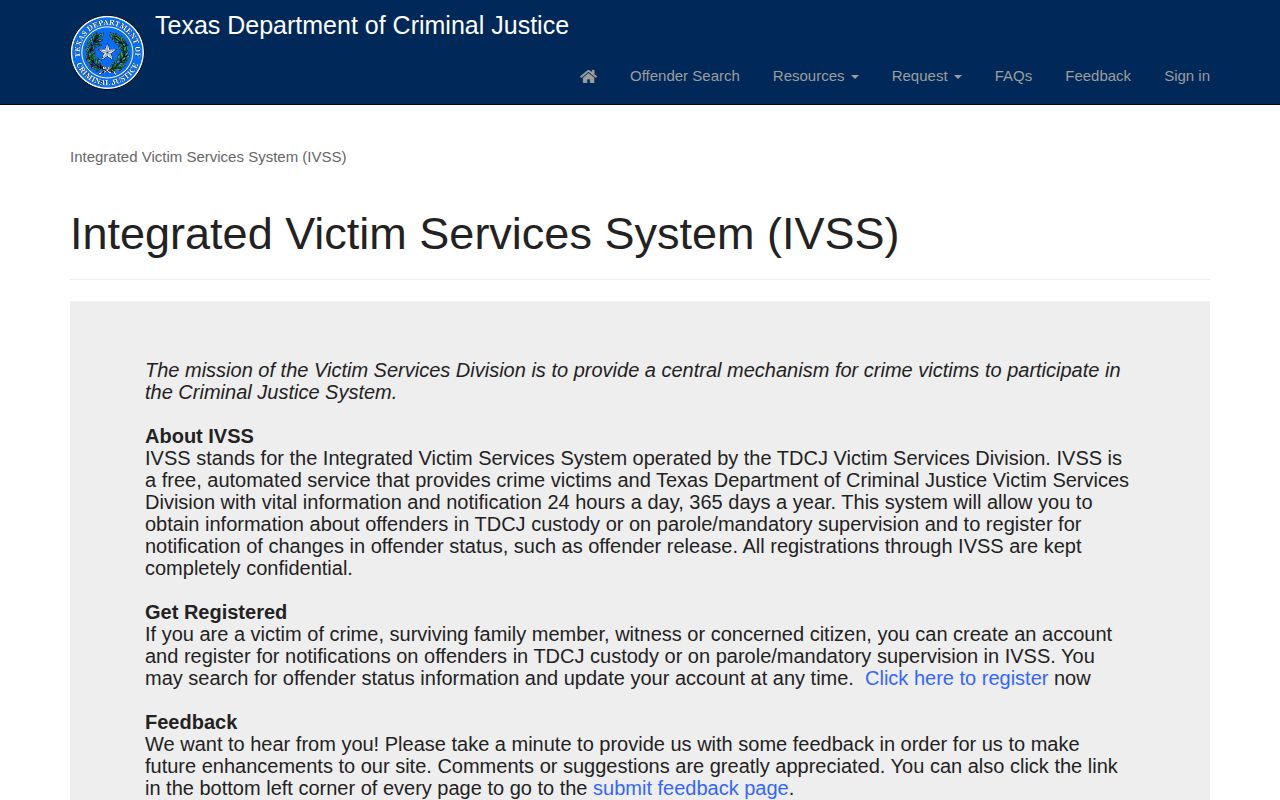
The IVSS interface illustrates the difference between custody, parole, and notification.
TDCJ Release Date Changes
TDCJ Classification and Records calculates the projected date. The offense title and offense date matter. Flat time, good-conduct credit, mandatory-supervision eligibility, a Board vote, disciplinary loss, jail credit, new sentence data, detainers, programming, residence-plan approval, and a records audit can alter the result. Government Code Chapters 498 and 508 supply major state authority, but no single percentage applies to every Texas sentence.
After a favorable vote, Review and Release Processing still verifies plans, conditions, county requirements, discipline, programs, and the release certificate. The scheduled date can change even on that day. A vote code or projected date is not proof that the person left the unit.
TDCJ Records and Contacts
TDCJ's no-charge email information service may return location, conviction offense, incarceration history, current incarceration, and Projected Release Date. Send the full name and seven-digit TDCJ number to pia@tdcj.texas.gov. If the number is unknown, use exact date of birth. If that is also unknown, TDCJ asks for approximate age and county of conviction. The service does not provide photographs.
TDCJ inmate and release informationGeneral: 936-295-6371 or 800-535-0283
Monday through Friday, 8 a.m. to 5 p.m.
Before a BPP vote: 844-512-0461
After a favorable vote: 512-406-5202
Classification and Records: 936-437-6231
Email: classify@tdcj.texas.gov
For exact time, transfer, or release documents, use TDCJ Open Records or Classification and Records. Records Management itself warns that it cannot answer individual custody and time questions. Texas Government Code Section 552.029 identifies categories of release and parole information that remain public, but it does not open the entire inmate file.
Where TDCJ Releases Occur
TDCJ says most releases use regional sites nearer the legal county of residence, conviction county, or approved release county. Some male cases, including certain detainer, security, or supervision circumstances, may release through the Huntsville Unit. Families should confirm both the date and release unit before travel. A current unit is not always the release site.
The statewide system reported 43 FY2024 releases tied to San Jacinto County of conviction: 38 prison releases, five state-jail releases, and no SAFP releases. This is not a county-jail count and does not say that the physical releases occurred in San Jacinto County. It is a state-system measure grouped by conviction county.
Release gratuity also varies by state release type. TDCJ guidance describes two $50 payments in qualifying parole or mandatory-supervision cases, $100 for a flat prison discharge, and no release money for state-jail inmates under the cited rule. These are TDCJ provisions, not county jail fees or benefits.
County Jail Versus TDCJ Release
A person who bonds out of San Jacinto County Jail is not thereby a TDCJ release. Use the sheriff's book-out record and court order. If the sheriff says the person transferred to TDCJ, then IVSS becomes the correct public path. This custody handoff explains why the same person may disappear from a county tool and later appear in a state system.
| Event | Correct custodian | Proof |
|---|---|---|
| Local bond or county sentence exit | San Jacinto County Sheriff | Booking/release sheet |
| Transfer into state custody | Sheriff, then TDCJ | Destination plus TDCJ intake |
| State parole or supervision release | TDCJ | Release Date and status |
| Federal or ICE transfer | Named federal custodian | Transfer record and matching locator |
The San Jacinto County release-record hub connects the sheriff, court, notification, and receiving-agency paths. A current-custody result and a completed release event answer different questions.
TDCJ Release Verification Details
When IVSS is unclear, use the contact matching the case stage. General inmate information handles basic status. The Board line applies before a parole vote. Review and Release Processing handles status after a favorable vote. Classification and Records addresses time, transfer, and release calculations. These offices can describe different stages without truly conflicting.
A favorable Board code needs plain reading. FI can authorize release when eligible or require a program first. NR denies release and sets another review. CU/SA denies release and requires service to a permitted date. DMS denies discretionary mandatory supervision. None proves the person physically left. The certificate, audit, programming, approved plan, and scheduled-site processing still matter.
Parole is conditional community release before discharge. Mandatory supervision is a separate statutory release form. Neither is probation. Probation comes from a court and is handled locally through San Jacinto County CSCD. A probationer may never enter TDCJ. The signed judgment is the public proof of that local route, while the sheriff event shows when county processing ended.
The release site also requires confirmation. TDCJ says most releases use regional sites tied to approved residence, conviction, or release counties. Some cases use Huntsville due to detainers, security, supervision, or other circumstances. The unit and release location can differ. Check both near the event and avoid travel based on an early projected field.
A state record may remain visible because parole or mandatory supervision continues. That differs from a former county detainee disappearing from IVSS-Counties. Preserve the status wording, release date, and date checked. For a durable result, request the state record instead of relying only on a changing screen.
San Jacinto Parole Records
San Jacinto County maps to the Conroe District Parole Office for TDCJ parole cases. The office is at 4301 South Loop 336 East in Conroe and lists 936-756-0420. This local mapping is a useful routing fact, not a public list of released people. IVSS remains the person search, while the assigned office handles supervision within its authority.
Ordinary local probation goes to San Jacinto County CSCD in Coldspring. Its account reporting and payment tools are private participant services, not public locators. Verify probation through the signed court order. Calling county probation about a TDCJ parolee, or calling TDCJ about an ordinary county probation order, sends the question to the wrong system.
Discharge also needs precision. A release on parole or mandatory supervision ends confinement but leaves supervision. A later discharge ends the sentence or supervision described by that record. Another cause can still exist. Read the actual status and date rather than shortening every state transition to “released.”
TDCJ's email information response is free for the defined status fields, but it does not provide photographs. Supply the full name and seven-digit TDCJ number. If unknown, give exact date of birth, or the approximate age and county of conviction requested by TDCJ. For exact release documentation, use Open Records or Classification and Records rather than treating the basic email response as the whole inmate file.